
Overview
The cerebral cortex is composed of 3 separate parts, the phylogenetically oldest being the paleocortex which forms the olfactory cortex, mediating perception of smell. The next is the archicortex which forms the hippocampus, mediating the limbic system. These 2 together are called the allocortex.
The neocortex, the most phylogenetically recent part, makes up around 75% of total human brain volume and is the top layer of gray matter. It covers each cerebral hemisphere and often referred to as the cerebral cortex itself. As this is, arguably, the most significant region of the brain, this website will focus on the neocortex.
The gray matter of the neocortex indicates the presence of nerve cell bodies, whereas the underlying cerebrum consists of white matter due to the presence of myelinated axons forming processes and tracts. It is estimated that in the entire human cortex there are around 1010 neurons, and in any square millimetre of cortex there are 103 neurons. This leads to around 10,000 synapses on every neuron within the cortex, an enormous number.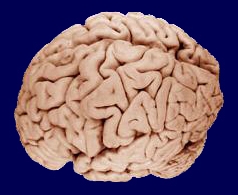
During evolution, the cortex volume increased more rapidly than the volume within the cranium, causing convolutions. Theses convolutions are known as the gyri, which are ridges, and the sulci, which are grooves. These visible structures allow distinction between different areas of the cortex, acting as ‘landmarks’.
During development, at the rostral end of the neural tube, the primary brain vesicle (the prosencephalon) differentiates into the secondary brain vesicle (the telencephalon). The neurons within this structure form the gray matter, from which the cortex arises.
Figure 1. Sulci and Gyri of Brain. Image Courtesy of Wikimedia Commons under Creative Commons Attribution 3.0 Unreported license. Author: WriterHound